The travel industry has always relied heavily on visuals. From glossy brochures to Instagram feeds, imagery shapes how destinations are perceived and who feels invited to experience them. But for decades, one persistent challenge has remained: representing diverse travelers authentically without incurring the high costs and logistical complexity of multiple photoshoots.
Today, that challenge is being addressed in an unexpected yet powerful way, through Face Swap AI. By enabling brands to adapt a single set of visuals to reflect a wide spectrum of identities, this technology is quietly reshaping how inclusivity is approached in travel marketing.
This article explores how Face Swap tools are transforming travel imagery, reducing production barriers, and helping brands move toward more representative storytelling without the need for repeated model shoots.
The Representation Gap in Travel Marketing
Travel marketing has historically leaned toward idealized, often narrow portrayals of travelers. A quick look at older campaigns reveals a lack of diversity across ethnicity, age, body types and abilities.
However, audience expectations have evolved. Travelers today want to see themselves reflected in the journeys being advertised. According to multiple industry reports, inclusive imagery not only improves engagement but also builds trust and emotional connection with audiences.
The challenge? Creating that diversity traditionally required:
- Hiring multiple models across demographics
- Organizing location-based shoots
- Managing styling, logistics and post-production
- Repeating the process for each campaign variation
This approach is expensive, time-consuming and often inaccessible for smaller travel brands or startups.
What Is Face Swap AI in the Context of Travel Imagery?
Face Swap AI image generation technology that allows the facial features of a subject in a photograph to be replaced or adapted while maintaining the original composition, lighting and environment.
Unlike traditional editing methods, modern AI-driven tools use advanced techniques rooted in deep learning in image processing to ensure realism, preserving details like shadows, expressions and perspective.
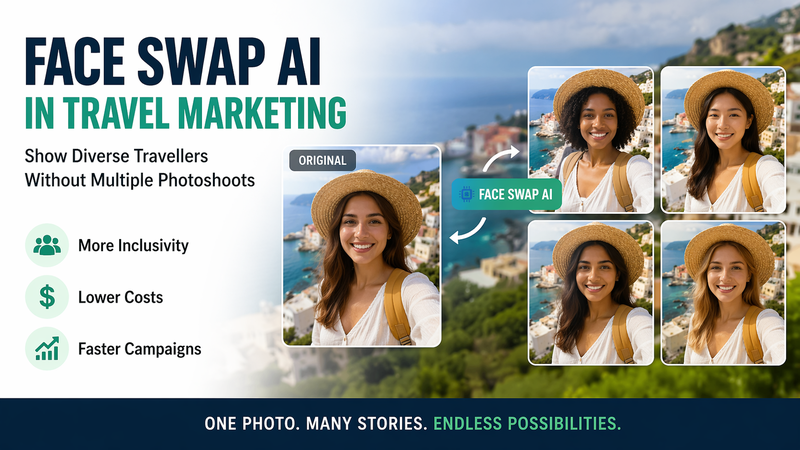
In practical terms, this means a single travel photo, say a person enjoying a beach in Bali can be adapted to represent multiple individuals from different ethnicities or age groups without reshooting the scene.
Reducing the Need for Multiple Photoshoots
One of the most immediate benefits is operational efficiency.
Cost Savings
A traditional travel shoot can cost thousands of dollars when factoring in:
- Location permits
- Photographer and crew fees
- Model contracts
- Travel and accommodation
- Editing and post-production
With AI-based face adaptation, brands can significantly reduce these costs by producing variations from a single base image.
Time Efficiency
Instead of coordinating multiple shoots across different locations or timelines, marketing teams can generate diverse visual assets within hours.
Scalability
Need 20 variations of the same campaign for different regions? Face Swap AI makes that possible without multiplying production efforts.
Enhancing Inclusive Representation at Scale
Inclusivity in travel marketing isn’t just about optics, it’s about belonging.
It allows brands to:
- Reflect a wider range of ethnicities and cultural identities
- Represent different age groups more accurately
- Include underrepresented demographics in aspirational travel scenes
This matters because representation influences decision-making. When people see themselves in travel imagery, they are more likely to envision themselves in that experience.
Research into human facial recognition patterns suggests that individuals are naturally drawn to faces they can relate to, reinforcing the importance of diversity in visual content.
Maintaining Visual Consistency Across Campaigns
One overlooked advantage is consistency.
In traditional shoots, variations in lighting, weather or photographer style can create inconsistencies across campaign assets. AI-based editing ensures:
- Uniform lighting and composition
- Consistent background and framing
- Cohesive visual storytelling
This is especially valuable for global travel brands managing campaigns across multiple regions.
A Practical Example: From One Image to Many Stories
Imagine a travel company promoting a luxury resort.
Instead of organizing separate shoots for:
- A young solo traveler
- A middle-aged couple
- A family
- A senior traveler
They can capture one high-quality scene and adapt the faces to represent each demographic.
This approach doesn’t just save resources, it allows brands to tell multiple stories using a single visual foundation.
Where Tools Like Higgsfield Fit In
As Face Swap technology becomes more accessible, platforms are emerging that make it easier for marketing teams to implement it without deep technical expertise.
One such example is Higgsfield, which provides a streamlined interface for generating realistic tailored for creative and marketing use cases. By allowing teams to quickly produce diverse image variations, it supports the growing demand for inclusive visual content.
Rather than replacing traditional photography altogether, tools like Higgsfield complement existing workflows, extending the value of each photoshoot.
Balancing Creativity and Authenticity
While this AI offers clear advantages, it also raises important creative considerations.
Avoiding Tokenism
Simply swapping faces without thoughtful context can feel superficial. True inclusivity requires:
- Cultural sensitivity
- Contextual relevance
- Authentic storytelling
Preserving Emotional Realism
Faces are central to emotional connection. Poorly executed swaps can break immersion, which is why high-quality tools and careful implementation are essential.
Ethical Considerations in AI-Generated Imagery
The use of synthetic media brings ethical questions that travel brands must address.
Transparency
Should audiences know when an image has been AI-modified? While there’s no universal standard yet, transparency is increasingly seen as best practice.
Consent and Rights
Using facial data whether from models or datasets requires clear permissions and ethical sourcing.
Trust and Brand Integrity
Travel is an experience-driven industry. Misrepresentation even unintentionally can damage credibility.
Discussions around the ethics of synthetic media highlight the importance of responsible use especially in industries where trust plays a central role.
The Role of AI in the Future of Travel Marketing
It is part of a broader shift toward AI-powered creativity.
According to industry insights on advancements in generative AI, content creation is becoming faster, more adaptive and increasingly personalized.
For travel brands, this means:
- Tailoring visuals for specific audiences
- Testing multiple campaign variations quickly
- Responding to cultural and regional nuances more effectively
Improving Engagement Through Personalization
Personalized marketing is no longer optional, it’s expected.
It enables:
- Region-specific campaigns with localized representation
- Audience-targeted ads that resonate more deeply
- Dynamic content for social media platforms
This aligns with broader visual marketing statistics, which show that personalized visuals significantly outperform generic ones in engagement metrics.
Supporting Smaller Travel Brands
Large travel companies may have the resources for multiple shoots, but smaller brands often don’t.
Face Swap AI levels the playing field by:
- Lowering production costs
- Reducing reliance on large creative teams
- Enabling high-quality output with minimal resources
This contributes to the broader democratization of creative tools, allowing more brands to compete visually.
Integration with Existing Workflows
One of the reasons Face Swap AI is gaining traction is its compatibility with existing creative processes.
Teams can:
- Start with professionally shot images
- Use AI tools to generate variations
- Integrate outputs into design platforms
This hybrid approach ensures quality while maximizing efficiency.
Limitations and Challenges
Despite its advantages, Face Swap AI is not without limitations.
Quality Variability
Not all tools produce equally realistic results. Poor execution can lead to:
- Unnatural expressions
- Lighting mismatches
- Distorted features
Creative Constraints
While AI can adapt faces, it cannot fully replace the nuance of human expression captured in real-life photography.
Ethical Risks
Misuse of the technology, intentional or not can lead to reputational issues.
Best Practices for Travel Brands Using Face Swap AI
To use Face Swap AI effectively, travel brands should:
1. Start with High-Quality Base Images
AI works best when the original image is well-lit and professionally composed.
2. Focus on Contextual Relevance
Ensure that the adapted faces align with the setting and narrative.
3. Maintain Transparency
Be mindful of how AI-generated visuals are presented to audiences.
4. Combine AI with Real Photography
Use AI as an enhancement tool, not a complete replacement.
5. Choose Reliable Platforms
Tools like Higgsfield can help maintain quality and realism in outputs.
The Bigger Picture: Inclusive Storytelling in Travel
At its core, the use of Face Swap AI is about more than efficiency, it’s about representation.
Travel is a deeply personal experience. The images used to promote it should reflect the diversity of the people who participate in it.
By enabling brands to showcase a broader spectrum of travelers, Face Swap AI supports:
- Greater inclusivity
- More relatable storytelling
- Stronger audience connections
Conclusion
Face Swap AI is transforming how travel brands approach visual storytelling. By reducing the need for multiple model shoots, it offers a practical solution to one of the industry’s longstanding challenges: balancing diversity with production constraints.
When used thoughtfully, this technology allows brands to create inclusive, engaging, and scalable imagery without compromising on quality or authenticity.
As tools like Higgsfield continue to evolve, the focus will increasingly shift from whether AI should be used to how it can be used responsibly and creatively.
In a world where representation matters more than ever, Face Swap AI is not just a technical innovation, it’s a step toward a more inclusive vision of travel.