The Canadian post-secondary landscape is currently witnessing its most significant pedagogical shift since the arrival of the internet. From the lecture halls of the University of Toronto to the research labs at UBC, the traditional “search and cite” model is being dismantled. In 2026, generative intelligence (GenAI) is no longer a futuristic novelty; it is a foundational research utility. However, for Canadian students, this transition isn’t just about using new tools—it is about a fundamental “re-learning” of what it means to conduct academic inquiry in a world where information is synthesized in seconds.
The stakes are particularly high in Canada, where academic integrity policies are being overhauled nationwide to distinguish between “AI-assisted research” and “AI-generated dishonesty.” As institutions move toward “AI-Literacy” requirements, students are finding that the old ways of skimming libraries and databases are insufficient. They are now required to act as “Architectural Editors”—individuals who must verify, cross-reference, and provide human oversight to machine-generated outputs.
Navigating this new era requires a balance between technological efficiency and traditional scholarship. Many students find that while AI can brainstorm, it often struggles with the nuanced requirements of Canadian rubrics or specific regional data. This is where professional assignment help Canada becomes an essential bridge, providing the human expertise needed to refine AI-generated drafts into high-distinction submissions that meet rigorous institutional standards. By blending technological speed with expert human validation, students can ensure their work remains both innovative and academically sound.
The 2026 Shift: From Data Collection to Data Verification
In the pre-AI era, research was defined by the “Search” phase—finding the right paper in a JSTOR database. Today, the challenge is no longer finding information, but verifying it. According to recent 2025-2026 trends in Canadian Higher Education, nearly 70% of professors have integrated “Verification Logs” into their assignments, requiring students to prove the existence of every citation.
The Rise of the “Reverse Research” Method
Canadian students are increasingly adopting a “Reverse Research” workflow. Instead of starting with a blank page, they use GenAI to map out the conceptual landscape of a topic. However, the “re-learning” occurs when they must manually hunt for primary sources to back up AI claims. This method prevents “hallucinations”—a common pitfall where AI invents Canadian case law or non-existent stats from Statistics Canada.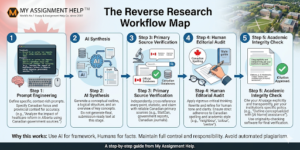
Localization Matters: The “Canada-First” Filter
A major hurdle for students is that many GenAI models are trained on US-centric data. Whether it’s legal precedents in Ontario or healthcare policies in Alberta, students are learning to apply a “Canada-First” filter to their research prompts. This involves using specific Canadian repositories like the Canadian Journal of Higher Education to supplement AI-generated outlines. For those looking to explore more technical intersections of this shift, reviewing contemporary technology research topics can provide a roadmap for how specialized fields are adapting to these digital assistants.
Data-Driven Insights: GenAI Adoption in Canada (2026)
Recent data suggests that the “AI-Gap” is closing, but the “Quality-Gap” remains.
| Metric | 2024 Statistics | 2026 Projections (Est.) |
| Students using AI for Brainstorming | 45% | 88% |
| Institutions with Mandatory AI Ethics Courses | 12% | 65% |
| Faculty using AI Detection Tools | 60% | 35% (Shift toward AI-Proctoring) |
| Reliance on Human Peer-Review/Tutors | 30% | 55% |
Source: Canadian Academic Trends Survey & Higher Ed Strategy Associates (HESA) Insights.
Managing Cognitive Load: The Role of Infographics
The complexity of modern research often leads to “Cognitive Overload.” Students are no longer just writing; they are managing prompts, verifying links, and checking for bias. Strategic use of visual aids helps simplify this process.
This diagram highlights that “Success” only exists where AI efficiency meets human critical thinking and institutional compliance.
The New E-E-A-T Standards in Student Research
In 2026, Canadian universities have adopted the E-E-A-T framework (Experience, Expertise, Authoritativeness, and Trustworthiness) not just for SEO, but for grading.
- Experience: Does the student show a personal connection or localized understanding of the Canadian context?
- Expertise: Is the technical terminology used correctly (e.g., referencing the Charter of Rights and Freedoms accurately)?
- Authoritativeness: Are the citations from reputable Canadian domains (.gc.ca or .edu)?
- Trustworthiness: Is the methodology transparent regarding AI usage?
Key Takeaways for the Modern Student
- Prompt Engineering is the New Writing: Learning how to “talk” to AI is as important as the writing itself.
- Verification is Mandatory: Never trust a citation provided by GenAI without checking a primary database.
- Human Oversight is the Gold Standard: High-level academic success still requires the “human touch” to ensure tone, logic, and ethical compliance.
- Use Professional Resources Wisely: Lean on specialized Canadian services to ensure your work aligns with local grading rubrics and regional English (UK/Canadian spelling).
FAQ: Navigating AI in Canadian Universities
Q: Is using GenAI considered plagiarism in Canada?
A: It depends on the institution. Most Canadian universities (like McGill or York) allow AI for brainstorming but consider “copy-pasting” without attribution as academic misconduct. Always check your specific course syllabus.
Q: How can I ensure my AI-assisted paper is “Canada-specific”?
A: Use “Grounding.” Feed the AI specific Canadian data or URLs from Canadian government sites to ensure the output isn’t biased toward US or International data.
Q: Are AI detectors reliable in 2026?
A: Many universities are moving away from detectors because of high false-positive rates. Instead, they are moving toward “Oral Defenses” and “In-Class Assessments” to verify student knowledge.
About the Author: Dr. Aris Thorne
Senior Academic Strategist at MyAssignmentHelp
Dr. Aris Thorne holds a PhD in Educational Technology and has spent over a decade helping students navigate the evolving digital landscape of Canadian higher education. Currently serving as a lead strategist for MyAssignmentHelp, Dr. Thorne focuses on integrating E-E-A-T principles into student support services, ensuring that academic assistance remains ethical, localized, and future-ready. When not auditing content strategies, Aris guest lectures on the impact of AI on the “Humanities” across various North American forums. Click here for more information.
References
- Statistics Canada (2025). “Digital Literacy and the Canadian Workforce.”
- Council of Ontario Universities. “Guidelines for Generative AI in the Classroom (2026 Update).”
- Journal of Academic Integrity. “The Evolution of Plagiarism in the Age of Synthesis.”
- HESA (Higher Education Strategy Associates). “The State of Post-Secondary Education in Canada 2026.